Make it a record of practice, not a record of achievement
A creative practice journal is a place to keep track of what happens while you make things. It can serve a painter testing color combinations, a musician working through a difficult passage, a gardener arranging a small container, or a writer trying different openings. Its purpose is not to prove that every session was productive. It is to preserve details you might otherwise forget.
Choose a format you can reach easily: a notebook beside your materials, a notes app, or a folder of dated files. If your hobby produces images or sounds, you can add a photo or recording alongside a short note. Start with what you already have rather than designing an elaborate system. The best format is one you can use even after a frustrating or brief session.
Capture the experiment in a few lines
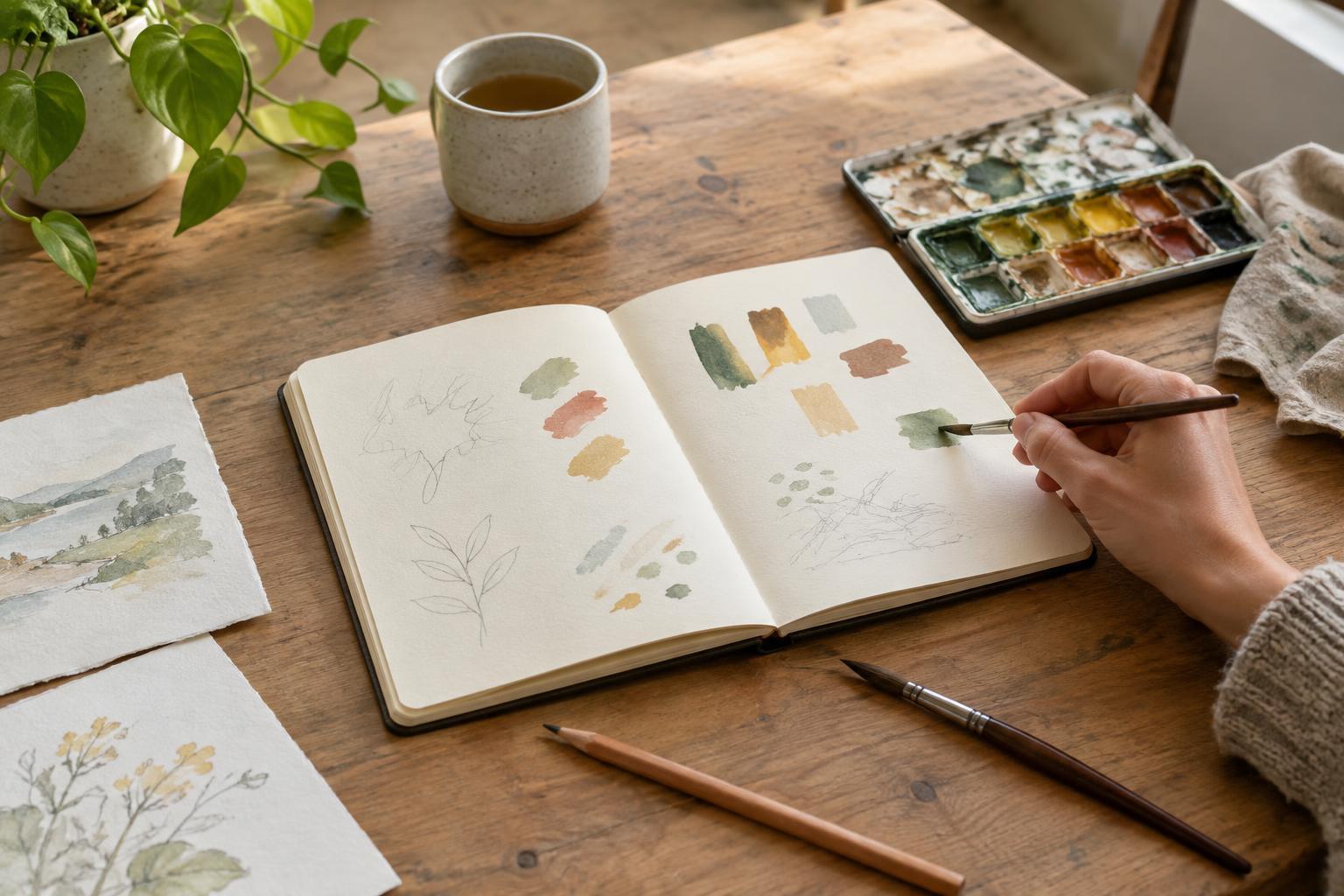
After each session, write down three things: what you intended to try, what you actually did, and what you noticed. For example: “Tried a limited palette for a quick sketch. Mixed most shadows from blue and brown. The colors felt more connected, but the face became muddy.” This gives your future self more to work with than either “good sketch” or “bad sketch.”
Include conditions when they matter. You might note which tool, material, recipe variation, or practice method you used. You can also mention a constraint, such as working for twenty minutes or using only scraps. Keep these details selective; you do not need a complete account of the session. A few specific observations are more useful than a long entry written from a sense of obligation.
If words feel awkward, use a rough drawing, a marked-up photo, a list of sounds, or a quick comparison between two attempts. Your journal should fit the way you work. It does not need polished prose or a consistent page layout.
Separate observations from judgments
It is natural to have an immediate reaction to your work. You may love the result, dislike it, or feel unsure. Record that reaction if it helps, but follow it with something you can observe. Instead of stopping at “the pattern looks wrong,” ask where it feels crowded or which repeated shape draws your eye. An observation points toward a possible change; a broad judgment often does not.
Pay attention to surprises as well as problems. A mistake may suggest a texture worth repeating. A tool you expected to dislike may be comfortable for one particular task. You do not have to turn every accident into a breakthrough. Simply noting what happened keeps an option available for later.
Use a brief review to choose your next attempt
Every few sessions, read back through your entries. Look for questions that recur: Are you repeatedly struggling with the same step? Does one material keep producing an effect you like? Are certain projects too large for the time you usually have? Circle one observation that seems worth testing rather than trying to fix everything at once.
Turn that observation into a small next experiment. If your sewn corners keep bunching, try two seam allowances on scrap fabric. If your story openings feel slow, write three versions that begin at different moments. Give the experiment a clear boundary so you can tell what you changed. You are not promising yourself a finished piece; you are creating a useful comparison.
End a review with one sentence beginning “Next time, I’ll try…” Put it where you will see it when you return. This reduces the effort of deciding how to begin, while leaving you free to change course if a better idea appears.
Keep the journal light enough to continue
A practice journal can become unhelpful if maintaining it takes more energy than making things. Set a low minimum: a date, one thing you tried, and one thing you noticed. Skip entries when you need to. You can restart without filling in the missing days or explaining why you were away.
Over time, the journal becomes a collection of choices, questions, and small discoveries. Some entries will lead to a new technique; others will remind you that an approach did not suit you. Both are useful. The point is not to document a perfect creative journey, but to give yourself a practical way to learn from the work you actually do.