Set up a small practice project
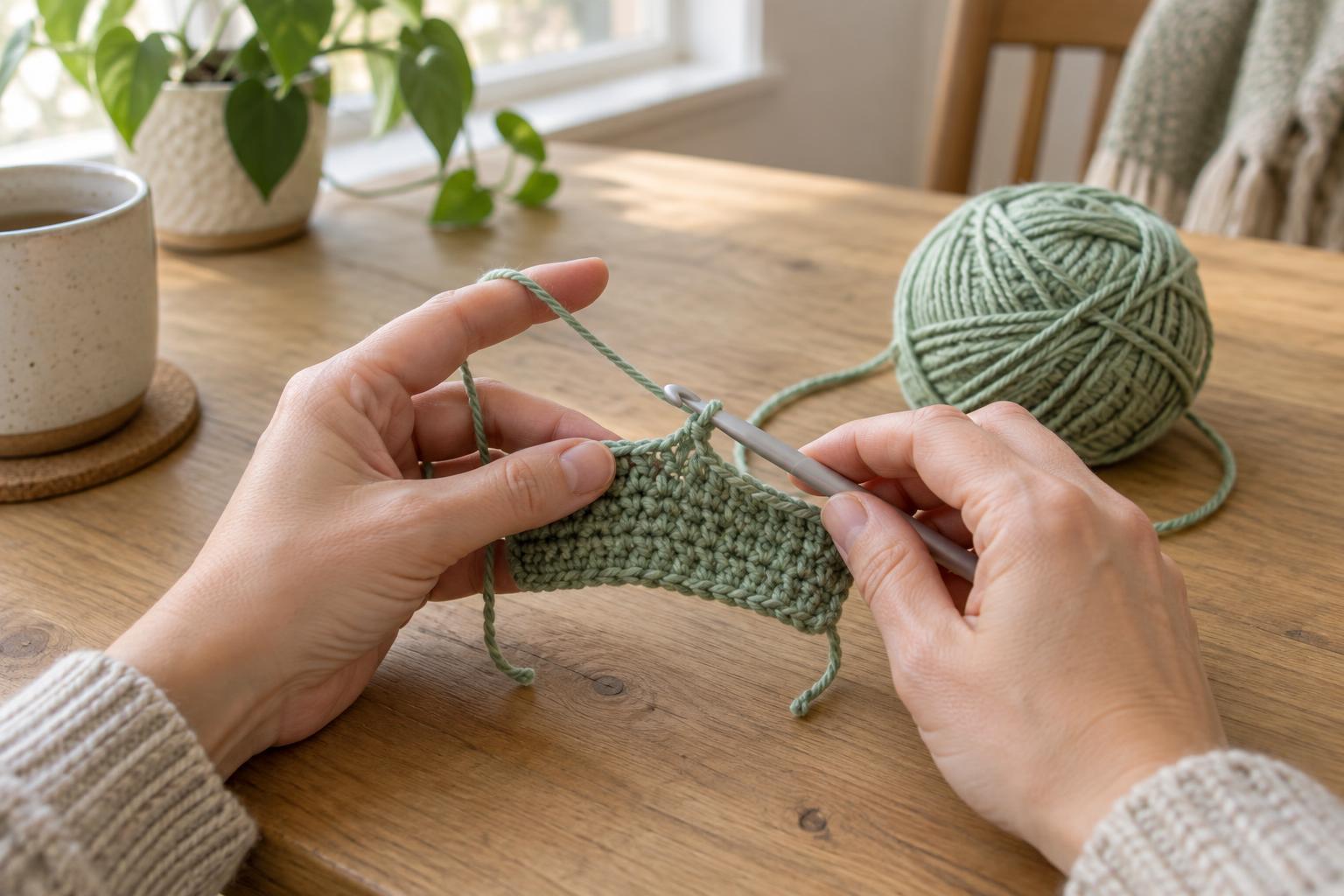
Your first crochet project does not need to become anything. A short practice swatch lets you get used to the movements without worrying about a finished shape. Choose a smooth, light-colored yarn so you can see each loop. Use a hook in the size range suggested on the yarn label, and keep scissors nearby. You can try a different hook later if the stitches feel unusually hard to work into or too loose to control.
Crochet instructions sometimes use different names for the same stitch. This guide uses US terms: “single crochet” is the stitch you will make across your first row. Start with the yarn end hanging free and the ball of yarn where it can unwind without rolling away.
Find a comfortable hold
Hold the hook in your usual writing hand. You might grip it like a pencil or hold it from above like a table knife. Neither position is required; choose the one that lets you rotate the hook without squeezing it tightly. The hook’s tip should be able to catch the yarn and then pass smoothly through a loop.
Use your other hand to guide the yarn coming from the ball. Let it travel over or between your fingers, then pinch the knot or stitches close to the hook with your thumb and finger. This pinch steadies the work. Yarn tension comes from how freely the yarn can move through your guiding hand, not from pulling every stitch tight. If your hands tire, pause and loosen your grip.
Make a slip knot and foundation chain
Make a loop near the end of the yarn, pull a small loop of the yarn from the ball through it, and place that new loop on the hook. Gently pull the yarn ends until the knot sits below the hook. The loop should slide along the hook’s shaft; it should not be cinched against the narrow tip. This is a slip knot, and it does not count as a chain stitch.
To make a chain, bring the yarn from the ball over the hook from back to front. This movement is called a yarn over. Catch the yarn with the hook and pull it through the loop already on the hook. You have made one chain. Repeat slowly until you have 12 chains. Each completed chain looks like a small V when viewed from the front. Count the Vs below the hook, not the working loop that remains on it.
Aim for chains that slide over the wider shaft of the hook. If each new loop is tightened around the tip, the first row may be difficult to enter. If the chain curls or looks uneven, you can still use it for practice; even spacing often becomes easier as the motion grows familiar.
Work your first row of single crochet
Keep the hook in the working loop and look at the chain you just made. Skip the chain closest to the hook. Insert the hook into the second chain from the hook, passing under a top strand of its V. For this practice row, continue inserting under the same strand of each chain. Hold the chain near the spot where you are working so it does not twist away.
With the hook inserted, yarn over and pull the yarn back through the chain. You should now have two loops on the hook. Yarn over once more and pull through both loops. One loop remains on the hook: that is your first single crochet. Move to the next chain and repeat—insert, yarn over, pull up a loop, yarn over, pull through both loops—until you reach the end.
Starting with 12 chains and working into the second chain from the hook gives you 11 single crochet stitches. Count the small Vs along the top of the row. If you have one more or one fewer, check whether you skipped an extra chain or worked into the same chain twice. There is no need to unravel immediately; identifying what happened is useful practice.
Turn, repeat, and notice what changes
To try another row, make one chain, then turn the work so you can crochet back across it. In this simple single crochet practice, treat that turning chain as a way to gain height, not as a stitch to count. Insert the hook into the first single crochet stitch, work a single crochet, and continue across. If you began with 11 stitches, aim for 11 again. Check the last stitch at the edge carefully; it can be easy to overlook.
A few short rows will teach you more than a long chain alone. Notice whether your hook passes easily into each stitch, whether your edges stay roughly straight, and whether your hands feel relaxed. If a stitch is too tight to enter, try leaving a little more room in each loop. If the fabric feels hard to control, slow down and pinch closer to the stitch you are making. You can unravel the swatch and use the same yarn to practice again.