Start with a map, not the first sentence
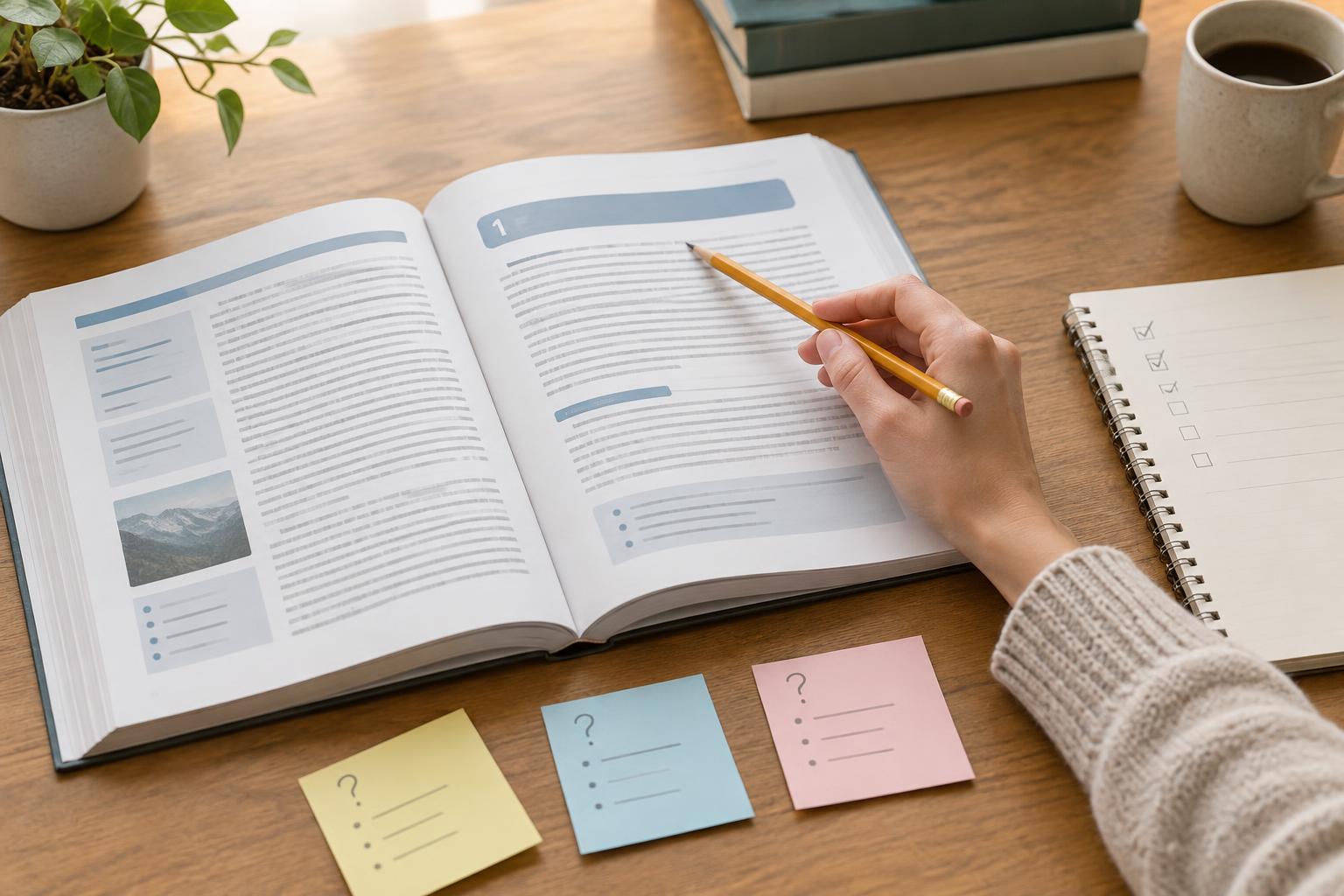
Reading a textbook chapter from beginning to end can feel productive while leaving you unsure what mattered. Before you read closely, spend a few minutes finding the chapter’s shape. Look at the title, introduction, section headings, diagrams, worked examples, summaries, and end-of-chapter questions. You are not trying to learn everything yet. You are identifying the main topics and noticing which parts may need more attention.
Then name your purpose. Perhaps you need to explain a concept for class, solve a particular kind of problem, or understand enough background to start an assignment. That purpose helps you decide where to slow down. If the chapter contains material you already know, you may only need to confirm your understanding. If a heading names an unfamiliar idea, mark it as a place to read carefully. A preview is a small investment that makes the detailed reading less directionless.
Turn headings into questions
Before reading each section, write one or two questions you hope it will answer. A heading such as “The Water Cycle” might become “What moves water between the ground, air, and oceans?” A heading about a mathematical method might become “When would I use this method, and what are its steps?” These questions give you something specific to look for without requiring you to predict the answer.
Keep the questions simple. You can use a margin, notebook, or document; the tool matters less than being able to find your questions again. As you read, add a question when a term, diagram, or example puzzles you. You do not have to interrupt every paragraph to investigate it. Mark the point of confusion, read on to see whether the chapter resolves it, and return if it does not.
This approach also gives your notes a useful shape. Instead of copying sentences that sound important, record brief answers in your own words. For a process, list its stages and what changes at each one. For an argument, note the main claim and the reason offered for it. For a worked problem, note why each step follows from the previous one. Your notes should help you reconstruct the idea later, not duplicate the page.
Check understanding before moving on
At the end of a short section, look away from the text and answer your questions aloud or in writing. If you can give a clear explanation and an example, you probably have enough understanding to continue. If you can only recognize the answer when you see it, reread the relevant passage and try again. Recognition is useful, but it is not the same as being able to use an idea.
Use the chapter’s examples as a second check. Cover the solution to a worked problem and attempt the next step yourself. For a diagram, try to describe what each label or arrow represents before reading its caption again. For a comparison, explain one meaningful difference between the two things being compared. These checks can reveal a gap more precisely than a general feeling that a page was “hard.”
When a check fails, make the next step small. Find the sentence that defines the key term, trace one example slowly, or write down exactly where your explanation stops making sense. If the chapter assumes knowledge you lack, note that prerequisite for a later review or a question to ask in class. You do not need to master every difficult point in one sitting to make useful progress.
Finish with a short return plan
After the chapter, revisit your original questions without looking at your notes first. Give each a brief answer, then check what you missed. Write a compact summary of the chapter’s central idea and two or three details that support it. If you cannot connect those details to the main idea, look back at the introduction or summary for the chapter’s intended thread.
Finally, decide what you will return to. Choose specific targets, such as “try one more equation of this type” or “explain the diagram’s three arrows,” rather than the vague task “reread chapter.” A later five-minute attempt to answer a question or work an example may show what stayed with you and what needs another look.
Preview, question, and check is a flexible routine, not a rule that every page deserves equal time. A dense chapter may call for shorter reading sections and more pauses; a familiar one may need only a few checks. The goal is to leave with a clearer account of what you understand, what you can do with it, and what to tackle next.