Start with the job your notes need to do
Notes are useful when they help you do something later: explain an idea, solve a problem, remember a process, or decide what to study next. Before choosing a format, ask what you will need to retrieve. If you need to follow the steps of a demonstration, a sequence may matter most. If you need to understand how several ideas influence one another, the relationships may matter more.
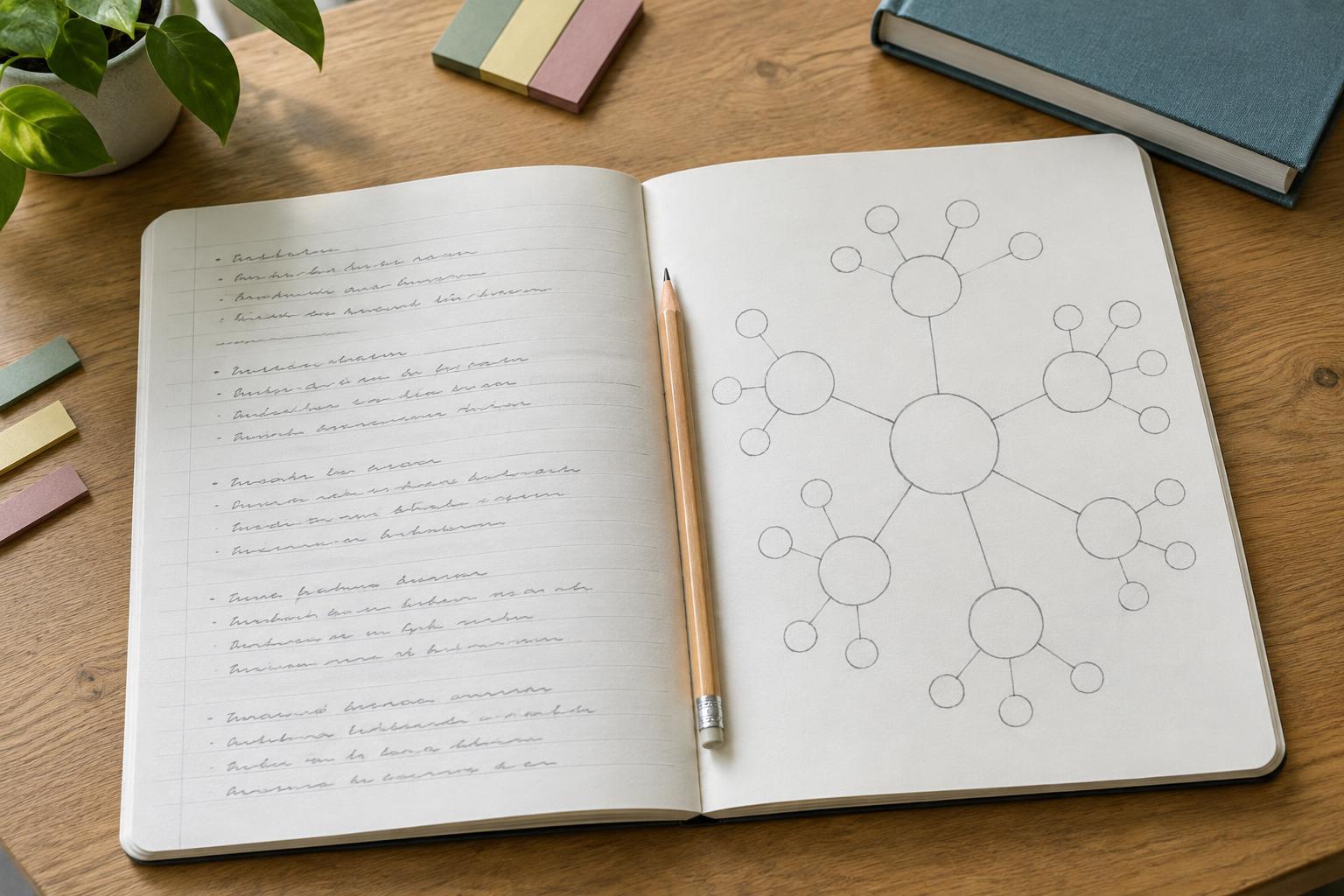
Linear notes and concept maps organize the same material in different ways. Linear notes run from one point to the next, usually in an outline or a series of short entries. A concept map places ideas in separate nodes and connects them with lines or arrows. Neither is a test of how deeply you understand a subject. The better choice is the one that makes your next task easier.
When linear notes are the better starting point
Linear notes work well when order carries meaning. For a software tutorial, you might record the setup, each action, and the result in the order they occur. For a reading assignment, an outline can preserve an author’s argument so you can see how one point leads to the next. Headings, indentation, and a few examples make these notes easier to revisit than a long transcript of everything you heard or read.
Their limitation is that connections across distant parts of the page can remain hidden. You may write a useful observation near the beginning and a related one much later without noticing the link. To reduce that problem, add short prompts in the margin or at the end: “How does this relate to the earlier example?” or “Where else does this principle apply?” You can keep the orderly record while making room for interpretation.
When a concept map earns its space
A concept map is useful when the main challenge is seeing relationships. Suppose you are learning how to plan a small project. You could put “project scope” in the center, then connect it to available time, materials, desired outcome, and tasks. Labeling the connections makes the map more informative: “available time limits scope” says more than a line alone. As you learn, you can add examples or mark links you are unsure about.
Maps can also expose gaps. If you can name two ideas but cannot explain how they relate, that blank connection gives you a question to investigate. The risk is making a crowded diagram that looks complete but is hard to read. Keep nodes short, draw only links you can explain, and split a large map into smaller ones if it becomes difficult to follow. A map is a working model of your understanding, not a display that needs to look polished.
Use both formats without duplicating everything
You do not have to choose one format for an entire subject. During a lesson or reading session, linear notes may help you capture unfamiliar terms and examples without interrupting your attention to arrange a diagram. Afterward, you can select five to eight important ideas and map their connections. This second pass asks you to decide what matters rather than simply copy your first notes into a new shape.
The reverse can work too. Start with a rough map when you are exploring a topic, then write a short outline when you need to explain it to someone else. The outline forces you to choose a clear path through ideas that the map shows all at once. Keep both versions only if each serves a purpose; otherwise, revise the one you are likely to use again.
Run a small test before settling on a habit
Choose a modest topic you can study in one sitting, such as the parts of a household repair or the basics of a new creative technique. Take linear notes for ten minutes. Then, without looking at them, sketch a concept map from memory. Check the source material and add what you missed. Finally, try to explain the topic aloud in a minute or two, using whichever page helps you recover the ideas.
Notice where you hesitated. Did you lose the order of a process, or did you struggle to explain why two ideas belong together? Let that answer guide your next attempt. Your preferred method may change with the subject and with your purpose. A dependable note-taking habit is not one fixed layout; it is the practice of arranging information so you can work with it again.