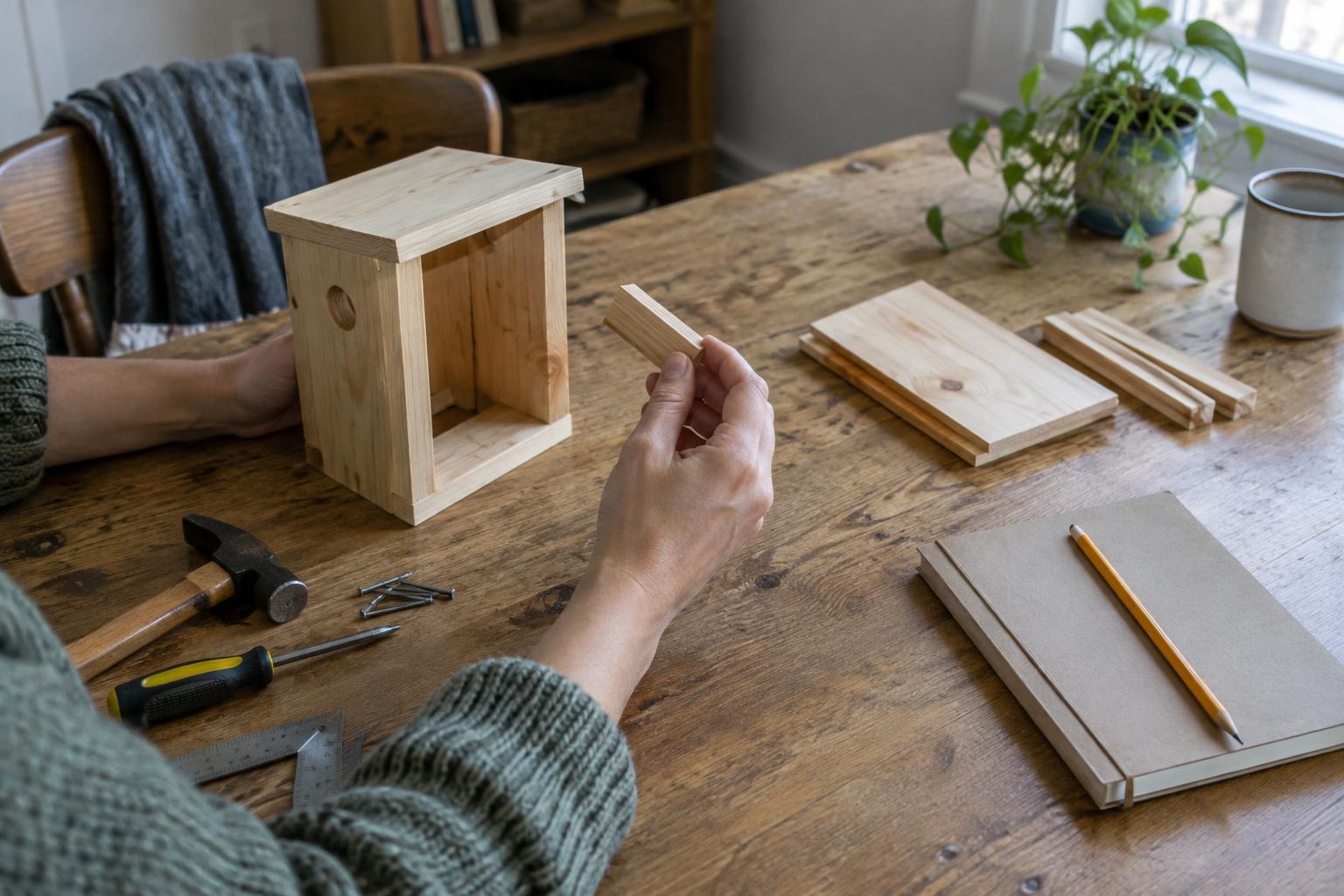
First, find out what stalled
A personal project can sit untouched for weeks while remaining vaguely present in your mind. You might still want the result, but the next step feels unclear. Or the project may have lost its purpose as your interests and responsibilities changed. Those situations call for different responses. Before trying to motivate yourself, spend ten minutes describing the project as it stands today.
Write down what you originally hoped to make or learn, what is already done, and the last action you took. Then finish this sentence: “I stopped because…” Give a concrete answer if you can: the materials became expensive, the next task was too large, you ran out of time, or you no longer enjoy the subject. If you do not know, that is useful information too. You can test a small next step rather than committing to the whole project again.
Separate the appeal of the finished result from your willingness to do the remaining work. Wanting a completed photo album, for example, does not necessarily mean you want to sort hundreds of images. That gap is not a failure of character. It is a design problem you can address—or a reason to let the project go.
Restart when the goal still fits
Restarting makes sense when the outcome still matters to you, the work is reasonably possible with your current resources, and the main obstacle is re-entry. Avoid beginning with a grand catch-up plan. It can turn one missed session into an intimidating backlog.
Instead, identify a task you can finish in one short session: open the project files, list the missing pieces, repair one item, or draft a rough outline. Set a stopping point before you begin. The purpose of this session is not to recover lost time; it is to learn what the project needs now. At the end, write the next visible action somewhere you will find it.
If the restart goes well, choose a pace you can repeat under ordinary conditions, not just on an unusually free weekend. A modest routine gives you room to notice whether your interest holds. If each session reveals a new obstacle, pause and reconsider the scope rather than repeatedly promising yourself a more energetic start.
Simplify when the idea is good but the plan is too big
Some projects stall because their first version quietly expanded. A plan to grow a few herbs becomes a complete garden redesign; a short story becomes a series. If you still care about the central idea but not the enlarged workload, define a smaller version with its own finish line.
Ask what the project must include to feel worthwhile, then remove anything that serves mainly to make it impressive. You could make one photo album for a single trip instead of organizing every family picture, or complete a three-page guide instead of building a full course. Write down what is outside the new scope so you do not have to renegotiate it every time you work.
A smaller version should be useful or satisfying on its own, not merely a vague promise to do less. Give it a concrete deliverable and a reasonable stopping rule, such as “choose and caption twenty photos, then order one copy.” Finishing that version may create momentum for more work later, but it does not obligate you to expand it.
Stop when the project no longer earns a place
Stopping can be the sensible choice when the goal no longer matters, the costs have changed, or you consistently prefer other uses for your limited time. The work you have already put in is real, but it cannot be recovered by adding more work to something you no longer want. Ask what you would choose if this project arrived on your desk for the first time today.
You do not need to erase the project to stop actively pursuing it. Save any files you may want, put reusable supplies where you can find them, and note what you learned. If other people are waiting for your contribution, tell them clearly what you will or will not finish. A brief, honest close is often kinder than leaving the project indefinitely “in progress.”
Try naming the decision precisely: “I am stopping the large version,” or “I am shelving this until I have a reason to return.” That is more informative than calling yourself someone who never finishes things. A deliberate stop protects time and attention for commitments you still value.
Make the decision small enough to test
If you remain unsure, run a limited experiment. Choose one action that will reveal something: spend thirty minutes on a restart task, sketch a smaller deliverable, or put the project away for two weeks and notice whether you miss doing it. Decide in advance when you will review what happened.
At that review, ask three questions: Did I enjoy or value the work itself? Is the next step clear? Does this project fit alongside my current commitments? Your answers do not have to be enthusiastic, but they should help you choose a direction. Restart if the work still fits, simplify if the scope is the obstacle, or stop if neither the process nor the result is worth pursuing now.
The aim is not to maintain a perfect record of completed projects. It is to make conscious choices about where your effort goes. A stalled project becomes easier to handle once it is no longer an undefined obligation, but a specific decision you are allowed to make.